
Nutrient Depletion in Pregnancy: Why Most Prenatals Aren’t Enough
Nutrient depletion is far too common throughout pregnancy and postpartum. We spend so much time hearing about what we shouldn’t eat when we’re pregnant, but there’s far less emphasis on what we should eat to have the healthiest pregnancy possible. Unfortunately, as a result, 95% of women experience nutritional depletion, even when taking a prenatal supplement.
Prenatal nutrition is important from the second you decide to start trying to start a family. If you’re already lacking certain nutrients before becoming pregnant, you’ll become more depleted throughout pregnancy because your body’s nutrient needs increase dramatically. This can not only impact the health of you and your baby during pregnancy, but it also impacts how you feel and recover postpartum.
Some key nutrients that I specifically focus on for prenatal and postpartum health include:
Folate is crucial during pregnancy for the development of baby’s central nervous system. A lack of dietary folate contributes to neural tube defects, so it is recommended to begin taking a folate supplement during your journey to try to conceive or as soon as you know you’re pregnant. Folate still plays an important role postpartum in red blood cell production and recovery.
Food sources include broccoli, spinach kale, legumes, liver, asparagus
Vitamin A needs increase during pregnancy because this nutrient is important for eye development and progesterone production. Vitamin A is a “Goldilocks nutrient” in pregnancy. While you need vitamin A to support baby’s health, you need to be mindful of the upper limit. .
Food sources include liver, eggs, fatty fish
Zinc also becomes incredibly important to your well-being during pregnancy and postpartum to support cell growth, immune function, and emotional well-being..
Food sources include pumpkin seeds, shellfish, liver, red meat
Choline is an often overlooked nutrient that is rarely found in the appropriate doses in prenatal supplements, but it is such an important nutrient to focus on while pregnant and nursing. It is estimated that approximately 90-95% of pregnant people don’t consume enough choline, so this is one nutrient you want to be especially aware of.
Food sources include egg yolks, soybeans, organ meat, broccoli, shiitake mushrooms
Vitamin D is often called the “sunshine vitamin” because the human body can actually make it when exposed to sunlight. However, if you live in a colder climate or spend most of your time indoors, you likely aren’t getting enough sunlight exposure and may need to look at additional sources of vitamin D. In pregnancy, vitamin D is essential for proper bone health for both you and baby. Maintaining adequate vitamin D levels also supports mood.
Food sources include fortified dairy and non-dairy milk, fortified orange juice, fatty fish, beef liver, egg yolks
Getting these nutrients through your diet is the gold standard, but that doesn’t always happen, and that’s ok! In pregnancy, food aversions and morning sickness can make this challenging. During postpartum, taking care of a newborn and your healing body make this challenging some days as well.
This is why I recommend a prenatal supplement for all my clients who are either trying to conceive,pregnant, or postpartum. I also recommend taking your prenatal for 6 months after giving birth (even longer if you’re nursing!) because most of us need a little extra nutritional support during this time.
There are a lot of different prenatal supplements on the market, so I commonly get asked which one is the best. The right choice for you is ultimately going to depend on your specific needs, which is why I recommend comprehensive lab work to assess your nutrient levels. However, a lot of prenatal supplements provide the bare minimum based on outdated standards. Many of the RDAs and DRIs for micronutrients during pregnancy are based on what is needed to avoid deficiency, but not what is actually optimal for your health.
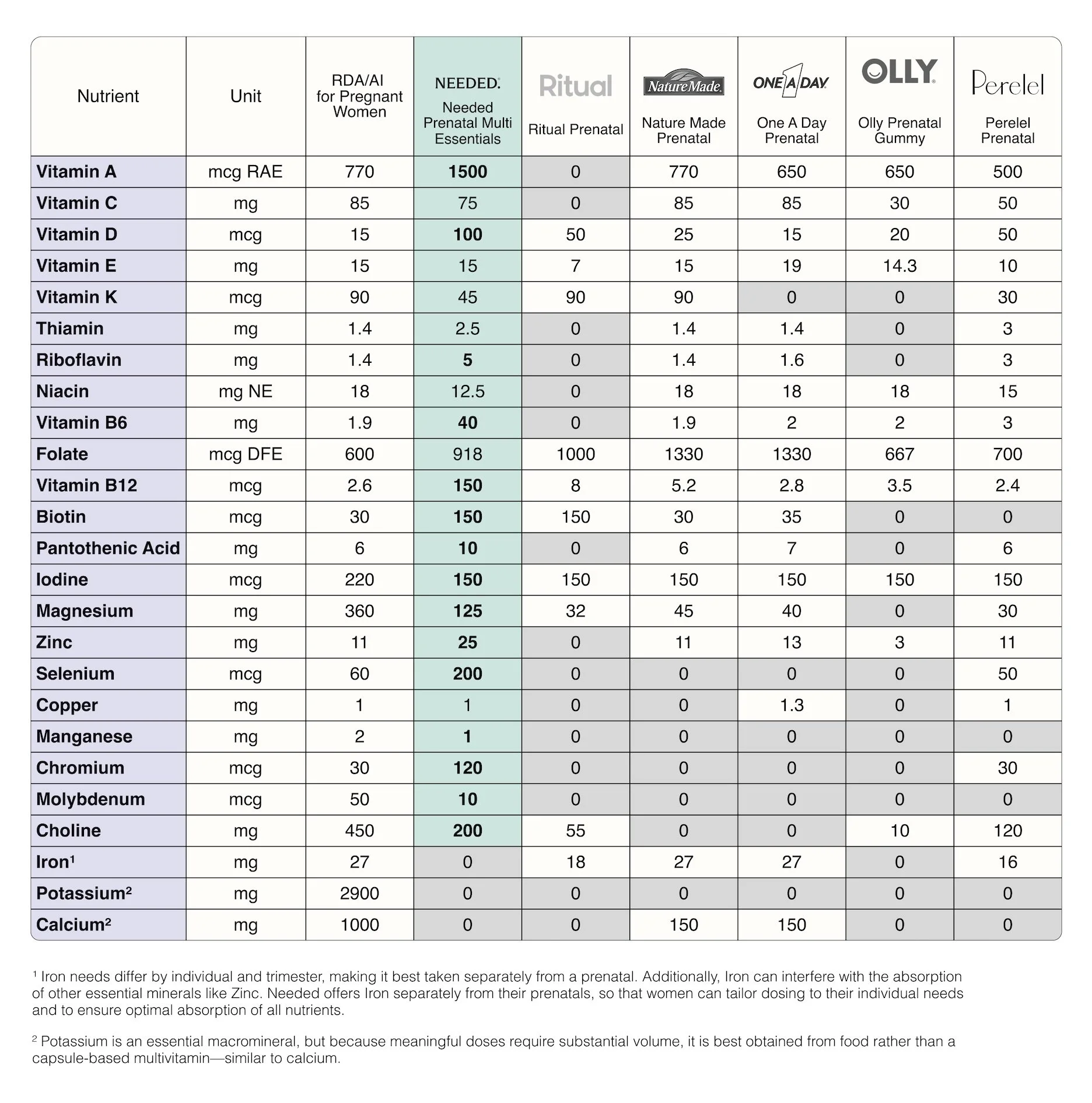
One of my favorite prenatal supplement brands is Needed. Their products are formulated based on what you need to replenish and optimize key nutrients during these life stages of increased demand. Their Prenatal Multi offers 8x more nutrition than leading prenatals.†
Needed’s Prenatal Multi provides bioavailable and high-quality forms of key nutrients, such as folate, vitamin A, zinc, choline, and vitamin D3. If you’re really struggling to keep up with nutrient-dense foods in your diet, I often recommend pairing Needed’s Prenatal Multi with their Choline+, Prenatal Iron, and Prenatal Omega supplements for the most well-rounded support.
This post is sponsored by Needed, a brand I genuinely recommend to my patients and use personally These statements have not been evaluated by the Food and Drug Administration. This product is not intended to diagnose, treat, cure, or prevent any disease.”
†Based on the total daily dosage of nutrients provided compared to leading prenatals as determined by IRI sales data as of December, 2025.
References:
Amini, S., Jafarirad, S., & Amani, R. (2019). Postpartum depression and vitamin D: A systematic review. Critical reviews in food science and nutrition, 59(9), 1514–1520. https://doi.org/10.1080/10408398.2017.1423276
Bastos Maia, S., Rolland Souza, A. S., Costa Caminha, M. F., Lins da Silva, S., Callou Cruz, R. S. B. L., Carvalho Dos Santos, C., & Batista Filho, M. (2019). Vitamin A and Pregnancy: A Narrative Review. Nutrients, 11(3), 681. https://doi.org/10.3390/nu11030681
Caudill M. A. (2010). Pre- and postnatal health: evidence of increased choline needs. Journal of the American Dietetic Association, 110(8), 1198–1206. https://doi.org/10.1016/j.jada.2010.05.009
Greenberg, J. A., Bell, S. J., Guan, Y., & Yu, Y. H. (2011). Folic Acid supplementation and pregnancy: more than just neural tube defect prevention. Reviews in obstetrics & gynecology, 4(2), 52–59.